
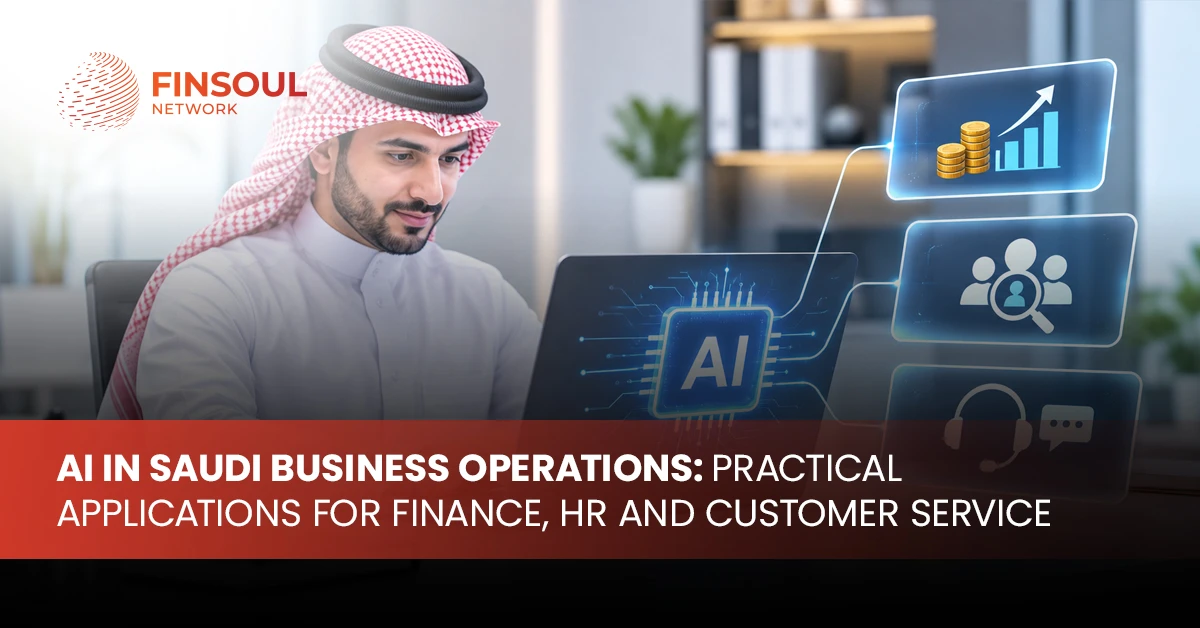
Saudi businesses are investing in digital operations, but purchasing AI software does not automatically produce better results. The commercial value comes from applying the right technology to specific operational problems: delayed financial reporting, time-consuming recruitment, rising customer service volumes and disconnected business systems. For companies operating in the Kingdom, successful adoption also depends on Arabic-language performance, reliable business data and compliance with Saudi data protection requirements.
AI solutions for businesses in Saudi Arabia now extend beyond chatbots and content generation. Companies can use predictive analytics to improve financial planning, automate document-heavy workflows, support HR teams and handle routine customer enquiries in Arabic and English.
How AI Is Changing Business Operations in Saudi Arabia
Saudi Arabia’s national focus on artificial intelligence, led by the Saudi Data and Artificial Intelligence Authority (SDAIA), reflects the Kingdom’s wider digital transformation ambitions under Vision 2030. The government designated 2026 as the Year of Artificial Intelligence, reinforcing the importance of AI adoption, infrastructure and skills development. For private businesses, the opportunity lies in translating this momentum into measurable operational improvements rather than adopting technology for its own sake.
The strongest business cases involve processes with high transaction volumes, repetitive decisions or substantial amounts of structured data. An organisation processing hundreds of supplier invoices, for example, has a different AI opportunity from a company whose main challenge is handling thousands of customer enquiries each month.
AI Applications in Finance and Accounting
Finance teams deal with recurring transactions, reporting deadlines, supplier documentation and financial decisions that depend on accurate information. AI can reduce manual processing and identify patterns that deserve closer attention, giving finance professionals more time to focus on financial control, planning and business performance.
Automating Invoice Processing and Financial Records
Invoice processing is a practical starting point for business automation in Saudi Arabia. AI-enabled document processing can extract supplier names, invoice numbers, dates, amounts, VAT details and payment terms from invoices, including scanned documents and PDFs. The extracted information can then be checked against purchase orders, delivery records and accounting system entries.
Saudi businesses also need to account for the Kingdom’s VAT and Zakat, Tax and Customs Authority (ZATCA) requirements. AI can assist with document classification and transaction checks and preparation of supporting records, but it does not replace the need to apply the correct tax treatment or meet applicable e-invoicing requirements. Automated checks must reflect the company’s actual transactions and current regulatory obligations.
Improving Cash Flow Forecasting and Budget Control
Traditional cash flow forecasts rely heavily on spreadsheets and assumptions entered by finance staff. AI-supported forecasting can analyse historical receipts, supplier payments, seasonal demand, outstanding invoices and other relevant business data to identify expected cash shortages or surpluses.
A contracting business, for instance, may have significant payroll and supplier commitments while waiting for milestone payments from clients. A forecasting model that incorporates expected payment dates, overdue receivables and planned project expenditure can help management identify funding pressure earlier and adjust spending or collection priorities.
Forecast quality depends on the quality of the underlying data. If payment dates are consistently inaccurate or project costs are incomplete, the resulting predictions will also be unreliable.
Strengthening Financial Analysis and Fraud Detection
AI tools can analyse large transaction volumes to highlight unusual expenses, unexpected supplier changes, duplicate payments and spending outside established patterns. These alerts help finance teams prioritise transactions that warrant investigation.
However, an unusual transaction is not automatically fraudulent. A large payment might reflect a legitimate contract milestone, a new supplier or an exceptional purchase. Finance staff must verify the supporting documents and approval trail before taking action.
Using AI in Human Resources
HR departments manage recruitment, employee records, leave requests, onboarding, policy enquiries and workforce reporting. AI can reduce the administrative work involved in these activities, but decisions affecting employment need stronger oversight than routine document processing.
Recruitment and Candidate Administration
AI recruitment tools can organise CVs, extract qualifications, identify relevant experience and compare applications against clearly defined job criteria. They can also help recruiters prepare interview questions and coordinate candidate communications.
For Saudi employers recruiting across different roles and locations, these functions can reduce the time spent sorting applications and managing interview schedules. A recruiter hiring for finance, operations and technical positions, for example, can use AI to organise applications by role and flag missing qualifications for review.
Automated screening must not become an unchecked hiring decision. CVs can contain inconsistent formatting, different job titles or information that a model interprets incorrectly. Employers need job-related assessment criteria, human review and checks for unfair outcomes. Candidate information must also be handled in line with applicable personal data protection obligations.
Employee Self-Service and HR Administration
Internal HR assistants can answer routine questions about leave procedures, onboarding documents, company policies and benefits using an approved knowledge base. Employees can obtain immediate answers to straightforward queries rather than waiting for an HR representative to respond.
The key is to connect the assistant to current, authorised company information. If a policy changes, outdated instructions must not remain in the system. Questions involving disciplinary matters, grievances, sensitive personal circumstances or disputed entitlements need referral to an appropriate HR representative.
AI can also support onboarding by generating role-specific checklists, tracking outstanding documentation and reminding managers about training or probation milestones. HR staff retain responsibility for verifying employee records, maintaining confidential files and completing formal employment procedures.
Workforce Planning and HR Reporting
Workforce planning becomes more useful when HR teams can analyse headcount, vacancies, turnover, overtime, absence and recruitment timelines together. AI-supported analytics can identify departments with persistent vacancies, highlight patterns in employee departures and help managers assess future staffing needs.
For example, a business opening additional branches can compare expected staffing requirements with current recruitment capacity and historical time-to-hire data. This supports earlier recruitment planning and more informed budget decisions.
AI-Powered Customer Service for Saudi Businesses
Customer expectations extend beyond office hours, and businesses serving Arabic- and English-speaking customers need consistent support across channels. AI can handle repetitive enquiries, retrieve approved information and direct more complex cases to the right team.
Arabic and English Chatbots and Voice Assistants
AI-powered customer service tools can respond to common questions about order status, appointments, opening hours, product availability, delivery procedures and account services. Depending on the integration, they can operate through a website, mobile application, messaging channel or telephone system.
Arabic capability deserves particular attention in Saudi Arabia. A tool that performs well in English may struggle with colloquial Saudi expressions, regional variations, mixed Arabic-English conversations or voice recordings affected by background noise. Businesses need to test the actual language and scenarios their customers use, not rely solely on a supplier’s general multilingual claims.
Personalised Customer Support and Faster Case Resolution
AI can retrieve relevant information from approved product catalogues, service records and customer histories to help agents respond more accurately. It can summarise previous interactions, suggest relevant answers and classify incoming cases by topic or urgency.
A service team handling warranty enquiries, for example, can use AI to identify the product, retrieve the applicable warranty terms and present the agent with the customer’s previous case history. The agent can then focus on resolving the issue instead of searching through separate systems.
Customer-facing systems need clear escalation rules. Complaints, payment disputes, account access problems and requests involving sensitive information must reach a qualified employee when automated handling is unsuitable. Businesses also need to prevent AI from inventing prices, promising unavailable services or providing information that conflicts with approved policies.
Measuring Customer Service Performance
The value of AI customer service is best assessed through operational results rather than chatbot usage alone. Relevant measures include first-response time, resolution time, repeat contacts, escalation rates, customer satisfaction and cost per resolved enquiry.
A chatbot that answers quickly but repeatedly sends customers to human agents has not necessarily improved service. Likewise, a system that reduces call volumes while increasing unresolved complaints may create additional costs elsewhere. Performance reviews need to consider the entire customer journey, including the quality of the final resolution.
Business Automation Saudi Arabia: Connecting AI with Existing Workflows
AI and business automation serve related but different purposes. Automation moves information through defined processes, while AI interprets documents, identifies patterns, classifies requests or generates responses where inputs are less predictable. Combining the two can remove manual hand-offs that slow down daily operations.
Consider a supplier invoice workflow. AI extracts the invoice details and identifies possible discrepancies. The automation platform checks the purchase order, routes the invoice to the relevant approver, records the approval and sends the authorised transaction to the accounting system. Invoices that fail validation are diverted for review instead of progressing automatically.
Similar workflows can support HR onboarding, customer complaint management, document classification and internal reporting. The most effective design defines which steps are automated, which decisions require approval and what happens when information is missing.
AI Governance, Data Protection, and Business Risks in Saudi Arabia
AI implementation involves more than software selection. Companies must understand what information enters a system, where it is processed, who can access its outputs and how decisions are reviewed.
Personal Data Protection and Confidential Business Information
Saudi Arabia’s Personal Data Protection Law (PDPL) and its implementing regulations are important considerations when AI processes employee records, customer details, CVs, contact information or other personal data. Organisations need to assess the purpose and lawful basis for processing, applicable transparency requirements, data minimisation, security measures and the conditions governing transfers of personal data outside the Kingdom.
Uploading employee spreadsheets, customer databases, contracts or financial records to a public AI service without an approved assessment creates avoidable exposure. Businesses need clear rules covering approved tools, permitted information, retention, access controls and vendor arrangements. Sensitive information must not enter an AI system simply because it is convenient.
Accuracy, Human Oversight and Accountability
AI-generated content can contain incorrect figures, outdated policies, fabricated explanations or misleading recommendations. This creates particular risks in financial reporting, recruitment, customer commitments and regulatory work.
Businesses need a review process proportionate to the consequences of an error. A draft internal summary presents a different risk from an automated payment approval or an employment recommendation. Material decisions require documented controls, clear responsibility and a way to investigate errors.
SDAIA’s AI governance and adoption resources provide a Saudi-specific reference point for responsible implementation.
How to Implement AI Solutions for Businesses in Saudi Arabia
Start with a Measurable Operational Problem
Select a process with a visible cost, delay or quality issue. Examples include lengthy invoice processing, high volumes of repetitive customer enquiries or time spent compiling monthly management reports. Establish a baseline before introducing technology so the business can compare results accurately.
Check Data Quality and System Readiness
Review whether the required information is complete, consistent, accessible and appropriately protected. Confirm that the proposed tool can connect to existing systems and that permissions prevent users from accessing records outside their responsibilities.
Run a Controlled Pilot
Test the solution on a defined workflow, team or transaction category before expanding deployment. Compare its results with the existing process, record errors and examine how it handles unusual cases. For Arabic customer service, include realistic Saudi expressions and conversations; for finance, test duplicate records, missing fields and mismatched amounts.
Establish Ownership and Staff Training
Assign responsibility for system performance, approvals, data access and incident handling. Employees need to understand what the tool can do, where its limits lie and when they must intervene. AI adoption works best when staff know how the technology fits into their responsibilities rather than treating it as a replacement for professional judgement.
Calculate Return on Investment
Measure time saved, processing costs, error rates, service quality and any additional software, integration, training or governance expenses. For instance, reducing invoice handling time has financial value only when the business calculates the actual hours recovered and accounts for the cost of implementing and maintaining the system.
Review performance after deployment. Changes in transaction volumes, business processes, regulations or software capabilities can affect results, so AI workflows need ongoing monitoring rather than a one-off launch.
Turning AI Adoption into Measurable Business Results
AI delivers business value when it addresses a defined operational problem and produces measurable results. For Saudi companies, that means choosing applications that fit local language needs, existing systems, workforce requirements and data protection obligations. Finance teams can accelerate routine processing and improve forecasting; HR departments can reduce administrative workloads; and customer service teams can handle repetitive enquiries without sacrificing the quality of human support.
Finsoul Network KSA supports businesses seeking more effective operational processes and better-informed technology decisions. A practical assessment of current workflows, system readiness and business priorities provides a stronger starting point than adopting AI without a clear purpose.
Frequently Asked Questions
What are the most useful AI solutions for businesses in Saudi Arabia?
Practical applications include invoice processing, cash flow forecasting, transaction anomaly detection, recruitment administration, employee self-service, Arabic-language customer support and automated reporting. The right choice depends on the company’s operating costs, data readiness and specific process bottlenecks.
How does AI support business automation in Saudi Arabia?
AI interprets information such as invoices, emails, customer messages and documents, while workflow automation moves that information between systems and approval stages. Together, they can reduce manual entry, speed up routine processing and direct exceptions to the appropriate employee.
Can AI tools handle Arabic customer service in Saudi Arabia?
Yes. Some tools support Arabic text, voice interactions and bilingual service. Businesses need to test Saudi dialects, local terminology, common customer requests and escalation procedures before deployment to confirm that the tool performs reliably in real conversations.
Is AI adoption subject to data protection requirements in Saudi Arabia?
Yes. When AI processes personal data, organisations need to assess their obligations under Saudi Arabia’s PDPL and applicable implementing regulations. They also need to review security, access permissions, vendor terms, data retention and any relevant cross-border transfer requirements.
How can a company measure the return on AI investment?
Compare the baseline process with post-implementation results. Useful measures include staff hours saved, processing time, error rates, cost per transaction, customer resolution time and service quality. Include implementation, integration, training and ongoing operating costs to calculate the actual financial return.