
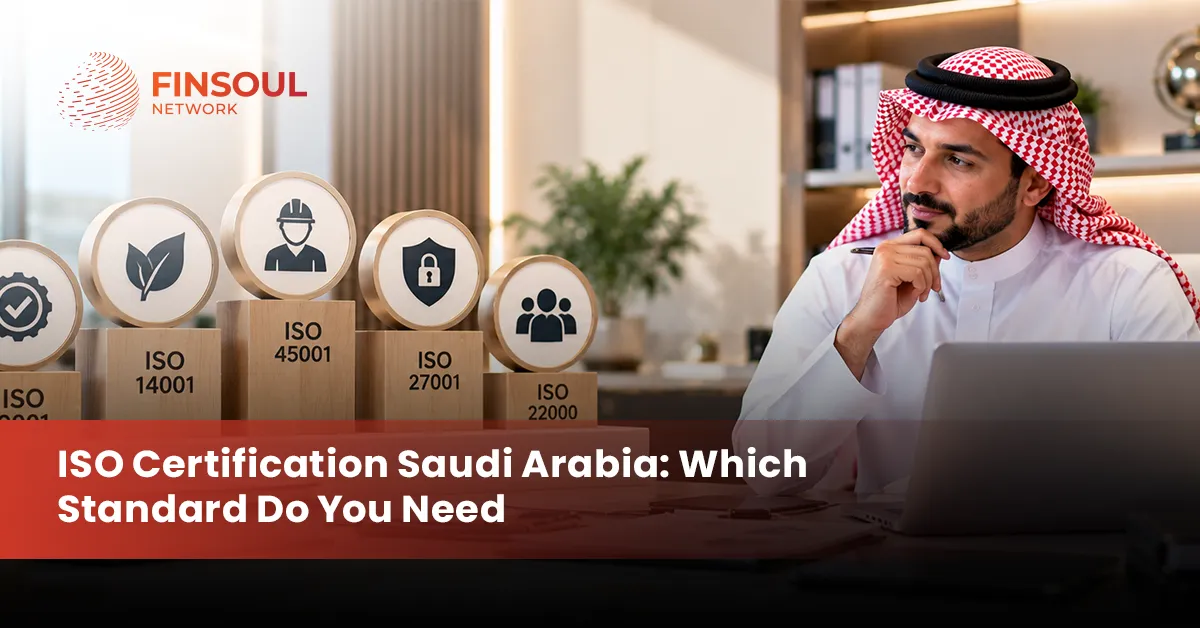
ISO certification in Saudi Arabia has moved from a nice-to-have to a standard line in procurement documents, supplier questionnaires, and investor checklists. The difficulty is that “ISO” is not one certificate. It is a family of standards, each built for a different problem, and the right choice depends on your industry, your customers, and the risks you actually carry. This guide explains the main standards, who needs which, and how the process works in the Kingdom. Finsoul Network KSA is mentioned where it helps show how outside support fits in.
What ISO Certification Really Means for a Business
ISO standards are published by the International Organization for Standardization, and they set out requirements for how an organisation manages a specific area of its operations. Certification is the independent confirmation that your management system meets those requirements. It is not a product approval, and it does not mean your company is perfect. It means you have documented, working processes that an outside auditor has tested.
This is why the phrase management system certification in Saudi Arabia keeps appearing in tender documents. Buyers want evidence that quality, safety or security does not depend on one careful manager. They want it built into how the company operates every day.
A certificate also has limits. It does not replace legal licences, sector regulations or technical approvals from bodies such as SFDA or the relevant ministry. Think of it as a framework that sits beside those requirements and makes them easier to meet consistently.
Why Saudi Businesses Are Pursuing Certification Now
Several forces push companies in the same direction. Government and semi-government buyers often ask for ISO certificates in prequalification, particularly in construction, facilities management, healthcare supply and IT. Large corporates apply the same rule down their supply chains, so a small subcontractor can be asked for a certificate it never needed before.
Vision 2030 programmes add another layer. Giga-projects, localisation drives and growing export ambitions all reward companies that can show consistent quality and risk control. Foreign partners and lenders also feel more comfortable working with firms that follow recognised international frameworks.
The Standards Most Saudi Companies Ask About
The list below covers the standards that come up most often in the Kingdom. Each one answers a different question about your business.
ISO 9001: Quality Management
ISO 9001 Saudi Arabia searches outnumber almost every other standard, and for good reason. It is the most widely recognised management system standard in the world and applies to any organisation, whatever its size or sector. It focuses on meeting customer requirements, controlling processes, handling complaints, and improving continuously.
If you are unsure where to start, ISO 9001 is usually the safest foundation. Many tenders list it as a baseline, and other standards share its structure, so adding them later becomes simpler.
ISO 14001: Environmental Management
This standard helps organisations control their environmental impact: waste, emissions, energy use, chemicals and legal compliance. It is most relevant to manufacturers, contractors, logistics companies and anyone working in oil, gas, petrochemicals or industrial zones. Environmental expectations are rising across the Kingdom, so interest is growing in other sectors as well.
ISO 45001: Occupational Health and Safety
ISO 45001 KSA enquiries come mainly from construction, oil and gas, manufacturing, transport and facilities services. The standard helps you identify hazards, reduce incidents and protect workers, and it replaced the older OHSAS 18001. Major clients commonly expect contractors to demonstrate strong safety systems, and a certified system supports that case. It also supports compliance with Saudi labour and safety requirements, though it does not replace them.
ISO/IEC 27001: Information Security
Technology firms, financial services providers, outsourcers and any company handling sensitive client data should look at ISO 27001. It covers how you assess and control information risks, from access rights to incident response. In Saudi Arabia, it works alongside national cybersecurity controls, such as those issued by the National Cybersecurity Authority, but it does not replace them. Many cloud and SaaS buyers now ask for it directly.
ISO 22000: Food Safety Management
Food producers, processors, packaging suppliers, caterers and distributors use ISO 22000 to build hazard control into their operations. It complements the licensing and inspection requirements of the Saudi Food and Drug Authority. For exporters, it often helps open doors with international retailers.
ISO 50001: Energy Management
This standard suits energy-intensive businesses that want to cut consumption and costs in a structured way. As energy efficiency becomes a stated national priority, interest from industrial and commercial building operators is increasing.
ISO 37001: Anti-Bribery Management
ISO 37001 supports organisations that want to show integrity controls to government bodies, partners and investors. It is relevant for companies that work in procurement-heavy sectors, deal with intermediaries or operate across several jurisdictions.
Other Standards Worth Knowing
- ISO 22301: business continuity, for organisations that cannot afford long disruptions.
- ISO 13485: quality systems for medical device manufacturers and suppliers.
- ISO 20000-1: IT service management, common among managed service providers.
- ISO 27701: privacy information management, which extends 27001.
Which Standard Fits Your Business? A Practical Guide
The shortest route to the right answer is to start with the risk or demand that is pushing you toward certification. The pairings below are typical, though your own customers may ask for something different.
- Contractors and construction firms: ISO 9001 plus ISO 45001, with ISO 14001 added for larger or regulated projects.
- Manufacturers: ISO 9001 as the base, ISO 14001 for environmental exposure and ISO 45001 for plant safety.
- Food and beverage companies: ISO 22000, usually alongside ISO 9001.
- IT, fintech and data-handling firms: ISO 27001, with ISO 9001 or ISO 20000-1 for service delivery.
- Facilities management and manpower suppliers: ISO 9001, ISO 45001 and ISO 14001.
- Healthcare suppliers and device makers: ISO 13485, with ISO 9001 as support.
- Trading and professional services firms: ISO 9001 is normally enough to start.
Before committing, read the actual tender or customer requirement. If the document names a specific standard and scope, that is what you need, regardless of what else sounds relevant.
Integrated Management Systems: Doing More Without Doing It Twice
Modern ISO standards share a common structure, so the clauses on leadership, risk, documentation, audits and improvement look similar across them. That makes an integrated management system practical. Instead of three separate manuals and three separate audit preparations, you build one system that covers quality, safety and environment together.
The savings are real. Management review meetings, internal audits, and document control can serve all standards at once, and your staff learns one way of working rather than several. Many certification bodies also offer combined audits, which reduces audit days and disruption.
The catch is scope. Each standard still has its own specific requirements, so integration must be done carefully to avoid gaps. A good consultant will map shared elements first and then add the standard-specific controls on top.
How the Certification Process Works in the Kingdom
The path is similar for most standards, though timing depends on your size, complexity and readiness.
- Gap analysis. A review of your current practices against the standard shows what already works and what is missing.
- System design and documentation. Policies, procedures, risk registers and records are developed or adjusted to match how you really operate.
- Implementation and training. Staff are trained, the system runs in practice and evidence builds up.
- Internal audit and management review. You test the system yourself before an outsider does.
- Stage 1 audit. The certification body reviews your documentation and readiness.
- Stage 2 audit. Auditors visit your sites, interview staff and check that the system works in practice.
- Certificate issued. If non-conformities are resolved, certification is granted.
- Surveillance audits. Annual checks follow, with full recertification every three years.
A small organisation can often complete the journey in three to six months, while larger or multi-site companies need longer. Rushing tends to produce paper systems that collapse at the first surveillance audit.
Choosing the Certification Body and the Consultant
These are two separate roles, and mixing them up causes trouble. The certification body performs the audit and issues the certificate. The consultant helps you build the system. Independence rules mean the same organisation should not do both for the same client.
When selecting a certification body, check its accreditation. In Saudi Arabia, look for accreditation from the Saudi Accreditation Center or from an accreditation body that is a member of the International Accreditation Forum. A certificate from an unaccredited body may be rejected by your clients, which defeats the purpose.
When selecting an ISO consultant in KSA, look for sector experience, a clear implementation plan, and a willingness to train your staff instead of writing everything for you. Be cautious about anyone promising certification in a fixed number of days regardless of your size. Finsoul Network KSA is one example of a provider that supports businesses with compliance and management advisory, and a short scoping conversation is a reasonable way to test fit before committing.
Mistakes That Make an ISO Audit in KSA Harder Than It Needs to Be
Choosing the Standard Last
Some companies start building a system and only later find out which certificate their customer wants. Confirm the requirement first, including the scope wording.
Copying Someone Else’s Manual
Templates are useful starting points, but auditors check whether your documents describe your real processes. A borrowed manual fails at the first interview.
Leaving Management Out
The standards require leadership involvement, and auditors will ask managers direct questions. If the owner never attends a review meeting, it shows.
Treating the Certificate as the Finish Line
Surveillance audits arrive every year. Systems that are not maintained produce non-conformities and, in worst cases, suspended certificates.
Setting a Scope That Is Too Narrow or Too Broad
A scope that excludes the activities your client cares about may not satisfy the buyer. One that covers sites you cannot control will cause problems in an audit.
What to Budget For
Costs vary with company size, number of sites, staff count and the standards chosen. Expect separate line items for consultancy, certification body audit fees, internal training and the time your own team will spend. Audit fees recur through surveillance and recertification cycles, so plan for the three-year picture rather than only the first year.
Ask each provider for a written breakdown and a clear statement of what happens if you fail to close a non-conformity within the allowed time. The cheapest quote often excludes the parts that cost most later.
Start With the Requirement, Then Build the System
The right ISO standard is the one that answers a real demand from your customers, your regulators, or your own risk profile. ISO 9001 suits most businesses as a first step. ISO 45001, ISO 14001, ISO 27001 and ISO 22000 follow when safety, environment, information or food hazards are central to what you do. Whichever you pick, a working system matters more than a framed certificate.
Confirm the requirement, choose an accredited certification body, bring in a consultant who trains your people, and plan for the annual audits that follow. If you would like support scoping which standard fits your business and how to prepare, speak with the Finsoul Network KSA team about your certification goals.
FAQs
Which ISO certification is best for a company starting in Saudi Arabia?
ISO 9001 is the most common starting point because it is widely recognised and applies to almost any business. If your main customers ask for safety or security certificates specifically, begin with those instead.
How long is an ISO certificate valid?
Three years, provided you pass annual surveillance audits. A full recertification audit is required before the cycle ends.
Is ISO certification mandatory in KSA?
Not by general law. It becomes effectively mandatory when a customer, tender or sector-specific rule requires it, so always check your specific contracts and regulator.
Can a small business get ISO certified?
Yes. The standards are designed to scale, and a small company often certifies faster because its processes are simpler. The system just needs to be proportionate to your size.
What is the difference between an ISO consultant and a certification body?
The consultant helps you build and prepare your system. The certification body is the independent auditor that decides whether you meet the standard. They should be separate organisations.
Can I certify more than one standard at the same time?
Yes, and many companies do. An integrated approach lowers duplication and audit time, as long as each standard’s specific requirements are properly covered.